Magic in Gualala, CA

California Art Club put together a “Paint Out” in Gualala, California this last month. I participated and really enjoyed it. There were about thirty-eight artists from all over California. For an artist, it is always fun to be around other artists. Two or three artists can be painting the same scene and they will all look entirely different.

The only downside was that I stayed in an old-world waterfront hotel. The room had a wonderful view, but It took at least ten minutes to get water warm enough to shower. The breakfast was either a stale wrapped Biscotti or a muffin of the same nature. I passed on both. There was no room service, so no clean towels, and I was there for six nights.

The beaches were clean and beautiful. The first day I painted at the park, with an expansive view.

I loved the view for viewing, but not particularly for painting. I’m not sure if that makes sense. I attempted to capture the beauty; but I felt something was missing for a painting. My opinion has not changed. Maybe it’s just too much information?

The next day, I visited a beautiful estate named “Barking Rocks.” It was named for all the seals that live on the rocks. There were about twenty of us painting around the waterfront property. I chose to paint a small and quick painting of the rocks.
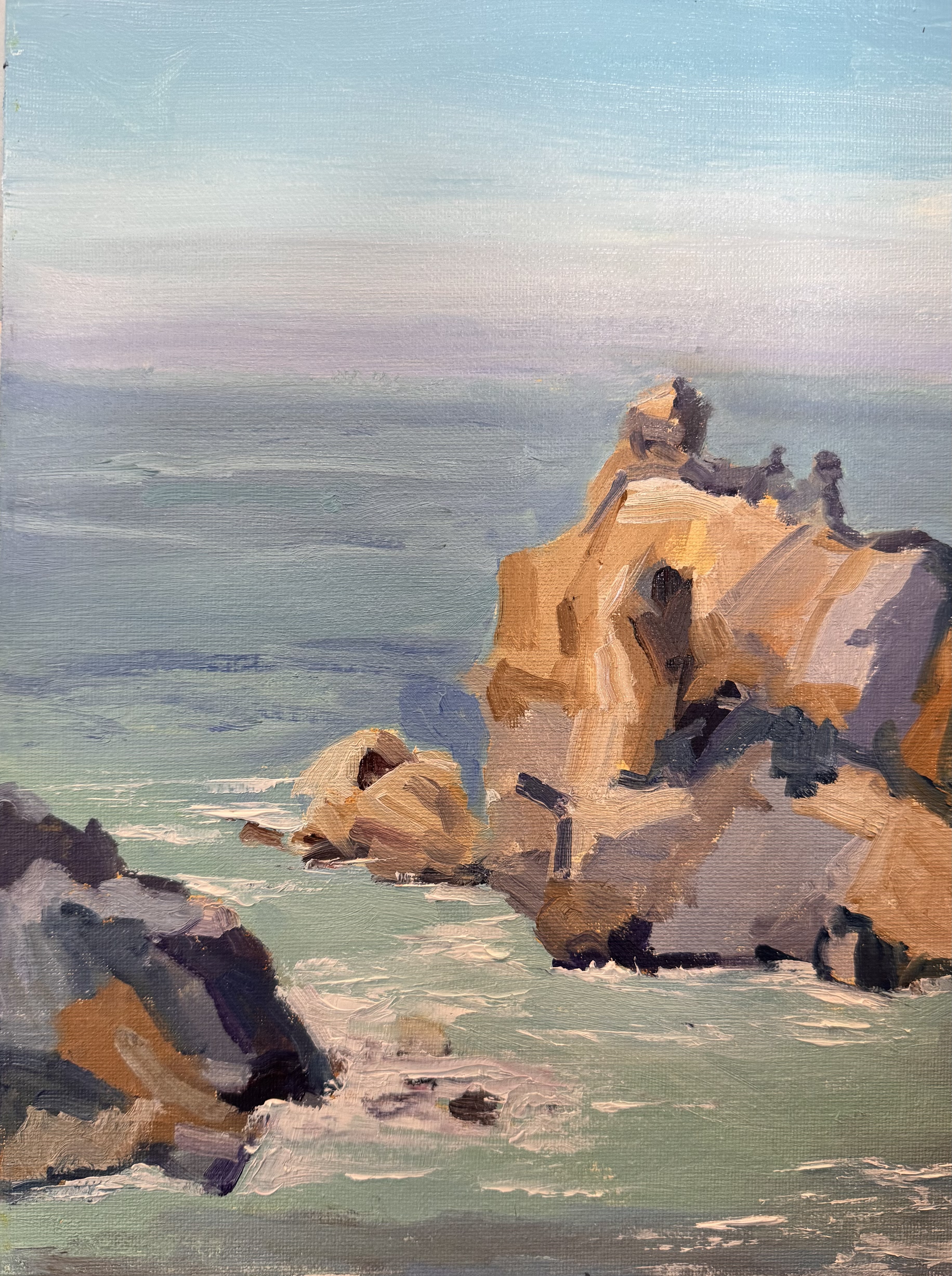
I was happy with this 8 x 10 and entered it the last day to be critiqued. No one found fault with it, so that was quite nice.

The third day I drove to Cooks Beach, where several of the group were painting. I joined on the cliff above the beach. Several others took the trail down to the beach and were painting on the beach.

I painted this on a 9 x 12 panel. I liked it when working on it.

The next day was too foggy to paint. I reworked the rocks in my hotel room. Gualala is a beautiful place, but does have fog that rolls in and you can not even see the beach. I drove south to Sea Ranch first and the further I drove, the thicker the fog. I chose not to stop at places where you had to hike quite a ways to the beach. I was by myself and did not want to run into “critters”.

I turned around and drove north toward the Pt. Arena lighthouse. When I got the road that takes you to the lighthouse the fog was fairly thick. I drove out to the lighthouse, but the fog was so thick I hardly saw it. I did not paint the foggy wonder, but it is one of the tallest lighthouses on the West Coast.

The effort to find a place to paint did not work well. I painted in my hotel room that day. The final day of the Paint Out, one piece of our work was critiqued by two well-known artists. It was fun to see what other people had painted. I would have loved to have seen the other pieces they had painted, not just the one. After the critique, it was time to head home.

I met many fun people and hope to do more with the California Art Club in the future. Here is the photo from our lovely cocktail party at Barking Rocks on Thursday night in their gallery. It was my second paint out. There were no awards, so it felt more casual than others.

Magic in Gualala, CA

How to Choose Your Next Painting Inspiration

If you are not out doing a Plein Air painting, how do you decide what to paint next? I keep file drawers with lots of ideas. I collect work from other artists for inspiration. I add anything that looks good to me from an ad or magazine at the moment. I look for great photos on Facebook and ask permission to use. When I travel I take lots of photos that “might” make good paintings.

Read my blog. You will see I just did a series of pen & ink drawings of Vacaville, California, where I currently live. I completed a few more drawings for the series I did for Winters, California. This was relaxation time in the evening, as I could watch a movie, draw and use watercolor in my home.

I did a series of animals for fundraiser for a local animal shelter named Funky Chicken. My pieces are selling very quickly as they are posted on “Shine A Light – on those that Inspire“. Each day a different artist’s work of animals from the shelter is put on Facebook for sale.

Right now I am working on a fun piece. It’s from a photo my daughter-in-law took. The photo features her two daughters and niece. They are at the beach in almost matching purple swimsuits. I wanted you to see them, not the water. Hope you like it.

So, now that this is done, what is next?

Many artists stay with one theme. They paint landscapes or portraits. They paint only still lives or fruit. I get “bored” with always painting the same theme, so like to try different things. Maybe I will paint flowers next?

If you are an artist, how do you decide what you want to paint?

Check out my website at: http://www.dianabennett.net

Check out my Instagram at: https://www.instagram.com/diana.bennett.artist/

Send a note to: dianabennett.artist@gmail.com

Add your name to mailing list to receive my latest blog.

How to Choose Your Next Painting Inspiration

Funky Chicken

A friend of mine is organizing a fundraiser for “Funky Chicken”, a 501(c)3 non-profit animal sanctuary in Northern CA. They rescue animals in need. Recently the owner was injured. She asked me to be a guest artist; as they sell paintings to people that follow their Facebook page. You can see the artwork on the “Shine A Light – on those that care”. All the artwork is 8″ x 10″ and available for sale at Shine A Light. Please check out both pages on Facebook.

Here are my contributions:

These and many other animals have been rescued by Funky Chicken near Vacaville.

I don’t often volunteer this much art, but love animals and hope this helps the shelter. Please look at the two different pages. You can buy some fun art or make a donation to this wonderful animal shelter. The animals will all be happy for your help!

Funky Chicken

What Can You Learn in an Art Class

I have always felt if I learn one new thing from a painting class, then it was worth the money. I took one last weekend at Folsom college, which is about an hour away from where I currently live. Setting up my easel, I realized my tripod was broken. I leveled my pochade box and just set it up on the table. That being solved I looked around the classroom and learned my first new idea. The man setting up next to me had put masking tape where his canvas sat. I thought this was so clever. I often put my finished painting in a frame. I set it on the easel to see what the finished project looked like.

Within the first five minutes I had at least one “ah ha”, and will do that going forward. Once the class began as I watched the demo, I was happy to see that the artist used many of the things I have been taught in other classes. What I loved was that he broke many of the “rules” from classes and teachers in the past.

He blocked out the design of the painting using Alizarin Crimson. He then used a roller or a large brush to indicate simple areas. It was a much faster way to begin a painting. He went on to share that every painting needs a story. He often writes a poem about his painting. I love that Idea! It is something I have started adding to all my work.

The story/poem for this first painting:

Being on a bus ~ not my favorite.
Being on a tour bus going to a wine tasting ~ getting better.
Being on the same bus ~ passing beautiful hay fields.
Now, this is good! Hey! Let’s have a glass of wine.

My first painting was from a photograph I took out of a bus ride in Hungary to go to a wine tasting at a well-know winery in the area. It was a beautiful day, and we kept passing hay fields with rolled bales. Having grown up on a farm, where we raised wheat and barley I love being out in the country. We were asked to bring our own photographs. The first day was to be a landscape. He had photographs, but if we used his photographs we could not sell our piece. I painted from a photo on my phone. It was a small photograph to work from. I promised myself I would learn how to move my photos to my Amazon Fire when I had time.

I started the painting by placing the trees and the bales. It was a fairly quick study, which I completed in a couple of hours.

Our teacher made only two suggestions. One was to darken the base of the trees. The other was to add a little green to the sky. I did both and was pleased with the result. One thing I have learned about photographing your work, is that it always views better in person and in a frame.

The next day he was going to be doing a demo on an ocean scene. I had several photos from Puerto Vallarta. I selected one off my phone because I forgot to bring photos to use as a reference. When I got home I printed a couple of photographs to take the next day. You can enlarge the photos to see a certain part. However, having a larger photo as a reference is easier.

My husband and I travel to Puerto Vallarta every year. I always enjoy the beach as it is shallow and you walk out a ways. It is also quite beautiful. I selected this photo as my second to paint.

Bringing the painting to life and wanting to draw you into the scene, I changed the colors a little. I wanted the focus to be more in the middle, where the waves are crashing. I wanted you to know the mountains are there, but not the place your eyes goes first. There were a couple of areas that drew attention to the wrong place. The instructor helped me decide what to simplify.

As I worked on this our instructor said: “When you think it’s done it’s already over-worked.” He came and said: “Leave it where it is, so you don’t lose the spontaneity of it.”

Poem/Story:
Does being at the sea bring you joy? Does it bring peace?Does it make you calm? What does? Does anything?

For my last painting of the class, I had about two hours remaining. I zeroed in on part of this photo. This allowed me to do a simple and fast painting. I finished the following painting in about twenty minutes. One of my good artist friends once pointed out: “When someone asks you how long it took to paint this piece, respond with how many years you have been studying. This indicates the effort you’ve put in to reach this point.” I have been painting about thirty years (off and on), so it really took more than twenty minutes to complete the painting.

This class was very successful for me, as I learned several new ideas. I will add them to the way I paint.

Poem/Story:

Let’s walk to the beach. I just walked down to the beach. The Light danced on the water. The surf sang songs of joy. And I knew the day was mine.

Enjoy your next class. Don’t expect to totally change the way you paint or think. Concentrate on learning something new and add it to what you already know and use. One new idea is better than none! I learned many other things in this class that I did not share, but totally enjoyed.

What Can You Learn in an Art Class

Traveling Art

When I travel I always take something along to sketch and paint with. We recently returned from a Viking River Cruise. For some reason I had expected to see wonderful sights all along the river. That just was not true. There were a lot of trees and many concrete levies along the way.

I found we spent many hours on buses taking us to locations away from the river. We started our cruise by staying in a lovely hotel in Bucharest for three days. The river was too low for the riverboats to pass. We wanted to see the Black Sea at Constanta. So, we took a seven hour bus ride to see the sea. It was lovely, but not a seven hour bus ride lovely?

The small painting above was from a photo I took from our first night on the Danube. We were on a boat with 194 people. There weren’t many “quiet places,” so it was difficult to find somewhere to sketch. I found a table in an area that served as a dining area most of the day. It was not particularly private.

As we continued our journey, I looked for fun things to sketch. This priest was sitting outside of a cathedral that we walked by in Constanta, Romania. I’m not sure of his purpose and it was quite hot, but I thought it was an interesting sketch.

Here is the photo that I took. I was using watercolor, which is unforgiving. I wanted to make his eyes closed as in the photo, but I accidentally made him look awake. It is not something I will turn into a painting, but it was a fun sketch.

Going through the locks for the first time I found this group of workers rather humorous. They were supposed to be working, but here they are chatting and on their cell phones.

I took some other photos on the trip that I plan to paint:

I’d love to know what you think would make a good painting. It was a fun trip, but it is always good to be home.

Traveling Art

“Tell me and I forget. Teach me and I remember. Involve me and I learn.” ~Benjamin Franklin

Over the years I have taken lessons from some well-known artists and some not so well-know. I’ve always believed that if I learned something new in my art. It was worth the money if I put it into practice. Sometimes when taking classes, you realize that the painter is successful with their art. However, they may not be successful in their teaching. I took a portraiture class last year. The artist was very precise in how she taught us the art of portraiture. These are a couple of portraits that I painted after the class was complete.

During the course of the class we had models that sat for us. It was so interesting to see the end result using the same model. The two on the right are the same model, painted on different days. The artist that taught the class painted beautiful portraits. I noticed that her female portraits might have all been sisters. She made every one of them look like a classic beauty. I loved that she can do that, but I wanted try to paint them in a more personal manner. I learned and practiced all the proportions and elements of portraiture from her. I tried to add my style to what I learned. I was actively engaged in the class. This involvement allowed me to discover my own approach to creating a portrait.

That said, it made me think about the part of the quote that says: “Involve me and I learn”. As I get a little older I find I have to write it down to remember it. Visually I will always remember, as I am a visual learner. When I travel, I have an easy time finding my way back to the hotel. I always remember what was in the display windows we passed on the way to our destination. Most artists are visual learners.

You can describe how to do something in a 1,000 words. In my case, one photo is enough and I get the idea. I love when artists show you specific techniques that work for them. It is fun to see if you can translate that into your personal style.

How often do you think you should take a new class from a different teacher? I took classes from the same teacher for twelve years. She painted beautiful paintings and I learned a lot about mixing color. I did not learn how to develop my own style. She and a couple other artists opened a small gallery. They would often paint there. They would try to sell their work. I was walking by the gallery one day with my youngest son. He asked me why I wanted to take classes from her. All the pieces in the gallery looked the same to him. That was the last time I took a class from her. It didn’t help that we did not agree politically. We were not allowed to disagree with her politics while in her class. I decided it was time to look for other art classes where politics were not part of the culture.

I went on to take art classes from many different artists. First I had to admire their work, to want to take a class from them. Second, they had to do something similar, but different than how I was painting at the time. I learned so many small tricks of the trade by taking classes from diverse artists. There were some classes I loved. There were some classes that I paid for, but did not go back for the second or third day. Some artists think they should discuss philosophy with you. If you do not agree with their view, then you are “wrong”. I think in any class, it is okay to agree to disagree.

I had a few favorite artists. I took several classes from them. I learned a little something new in each class. Some artists think it’s all in the detail, whereas other artists don’t believe in detail. Photorealism is something I appreciate, but not something I would ever attempt for my own art. I love the idea of something without the perfection of detail. I want more to capture a mood, than painting a perfect copy of a scene.

As I traveled more, I discovered something important. I studied the brushstrokes up close of the masters of the past. We can study them in Art History. However, you can’t really feel them until you are a foot from them in real life. Manet’s work comes to mind, as his brushwork is bold and intentional. You can’t see that in any photo. Going to art museums is a great way to get involved in how things are done. What captures your attention first in any piece you view? To my mind, each artist has a different way of representing his world.

The portrait classes were just a few of the classes that made me think. It is much easier to attend a class and try to mimic the artist/instructor. It is more challenging to take their ideas and make them your own. There have been classes that I have taken when I liked the work of the artist at that time in their lives. As their work changed, the end result was different. I had to think if I wanted to take any more classes from them.

My suggestion is to look at an artist’s work over time and think if you want to apply any of their style to your own art. If there is something that draws you to their art, then by all means get involved in a class or two they are teaching.

I think of Benjamin Franklin’s quote when it comes to cooking, another love in my life. I always loved the cooking classes that were “hands-on”. Once my fingers were in the dough, I would not forget how it felt. I feel designing wonderful food is another art form. It is presumably why I am drawn to it. If I am not painting or writing about art I am cooking. See you in the kitchen!

“Tell me and I forget. Teach me and I remember. Involve me and I learn.” ~Benjamin Franklin

“We are what we repeatedly do.

Excellence, therefore, is not an act but a habit.” ~Aristotle

I love this quote by Aristotle. It reminds me of what Malcolm Gladwell wrote in his book: “Outliars”. Ten thousand hours of deliberate practice are needed to achieve expert-level mastery in any field. While the 10,000-hour rule has become widely known, some argue it’s an oversimplification. They emphasize the importance of the quality of practice over just the quantity of hours. Regardless, the rule highlights the significant time investment required for true expertise.

As an artist I am often asked how long a certain piece takes to paint. Each individual piece may take a day or two or more depending on the actual size and complexity of the painting. It is not the time that an artist takes to make the one painting. It is the years and years of practice. time spent in classes, time spent reading articles about composition and color that need to added to the time spent. It is the time spent finding something interesting to paint. The time deciding the best composition and color combination add to the time over the years.

I personally collect books by artists I love and read them often. I collect art magazines and scour them for paintings I enjoy and respect. I keep files with examples of ideas I want to incorporate into my artwork. I always have a folder on my computer of things I want to paint next.

When I lived in Washington State, I had a much larger art studio. I did big abstracts, which I sold via an interior design and decor store. I don’t have that connection where I now live. When you move to a new area I think it is hard to reinvent yourself for the area.

The painting at the top of the page is 10″ x 20″ which I completed in two days. I think painting vineyards is a challenge. Trying to make rows of growing grapes interesting and colorful is not easy. I must have repainted the rows several times before I was content with the result. When I looked back, I realized the tree was fading into the background. It did not stand out the way I wanted. At that point in time, I lightened the rows, so the tree would stand more as a focal point.

I have a T-Shirt that says: ” Art is intelligence gone creative”. It is a compelling statement that highlights the connection between intellect and artistic expression. 

Here’s how intelligence and creativity intertwine to create art:

  •  Intelligence is the ability to learn and understand, providing artists with the knowledge and skills necessary to create. This includes understanding artistic principles, techniques, and historical context.
  • Creativity is the ability to generate original and unusual ideas. It allows artists to transcend mere technical proficiency.
  • Artistic talent emerges from a synthesis of creativity and intelligence. Imagination is combined with an understanding of various factors. These factors include culture, emotion, and technical aspects.
  • Art serves as a channel for artists to communicate ideas, evoke emotions, and tell stories. This requires a level of intelligence to effectively convey meaning through chosen mediums.
  • AI tools can help in artistic creation. However, they presently lack the emotional and conscious elements. These elements drive true human creativity. AI can analyze and mimic patterns, but human artists infuse their work with personal experiences, intuition, and unique perspectives. 

In essence, art is more than just raw creativity or intelligence alone. It is the intelligent application of creative thought and skill. This application produces something meaningful and impactful. 

Every artist I know wants to create something beautiful or thought-provoking. They make you look at things in a different manner. This all takes time, merged with intellect and creativity.

Next time you want to ask an artist how long a piece took to paint, stop to consider asking a different question. Maybe ask how long they have been studying art. Ask how long they have actually been applying paint to canvas.


“We are what we repeatedly do.

“You are never too old to set another goal or dream a new dream.”

Quote by C.S. Lewis

As I grow older in life I think about this more often. In my younger life I designed and built three homes at different locations, learning something from each design. At this point in my life, I live in a home I did not design. It is a wonderful little California Bungalow on a main street in a fairly large city. My other homes had been on waterfront or the beach. Planning and building another one at this point in my life is not viable.

Setting goals is important at any age. We all need to dream a new dream to have something to look forward to doing. I’ve had an art studio for years. They have been all different sizes and shapes and locations. I dreamed of being able to spend more time painting in my studio. Now that I am retired, I am living that dream. I need to find more places to actually sell the art I am creating. I guess that is a goal!

Today I finished this 10 x 20 inch painting of a nearby vineyard. I find painting grapevines more challenging than many other things that I paint. While there are always rows and rows of grapevines, how do you make them beautiful and interesting?

With so many rows, mostly the same, where is the “Focal Point”? That brings up a good point in the design of painting. I was taught that you always have to have a focal point in any painting. I see many famous paintings without one. It makes me question: “Do you have to have a focal point in your life”? When I was younger, it was my family and work and art sneaking in occasionally. Now that my sons are grown and all successful, I don’t have to worry about them as my focal point. I’m not working anymore. Although I would love to find a part-time job, I no longer have work as a focal point.

My art is my main focal point. It is hard to focus on something you love if you can’t find places to sell your art. Do you have to find something else to dream about? Do you have to find another goal to set?

I dream about going to Ireland, Scotland, Wales and England. I want to go before I am not capable of travel and really enjoying it. This is why I set a goal to work out four times a week. Additionally, I try to walk 10,000 steps a day. Here’s a funny fact. I am the oldest member of Kaia Fit in the city where I live. I keep up with everyone in the class. (Maybe my weights are a little lighter than those in their thirties. )

Here are some questions for you:

  1. How many goals do you need at any given time in your life?
  2. Do you put them in order of importance? Do you have a list?
  3. What is your dream? Do you share it with other people?

“You are never too old to set another goal or dream a new dream.”

Art Studio Safety Tips: Lessons from a Painful Fall

I never thought of working in my studio to be dangerous. I am beginning to think twice about that now. Last week while working on a new painting, I was concentrating on the painting. I wasn’t concentrating on where I was. I wasn’t focused on what I was sitting on. As a result, I “missed” my stool when sitting down. I work in a remodeled small garage in a 1915 Craftsman home. The floor in my studio is concrete, which is normally just fine. I have a thin carpet over it, with no padding. (Mistake # 2). Mistake # 1 was using the rolling stool.

As I slightly missed the stool, I lost my balance and bounced to the floor landing on my derriere. That was okay. Still, I kept on going down. I bounced off the concrete on the back of my head. My glasses went flying and I was not only feeling a little stupid, but my head hurt like hell. So now, I’m laying on the floor, my Apple watch is screaming: “Have you fallen? Do you need to call 911?” I can’t see well enough without my glasses to find the button. I can’t turn off the emergency call to 911. I am thinking an ambulance is soon to be on its way. I am really going to be embarrassed. After a few moments, I managed to put on my glasses. I turned off the emergency call on my Apple Watch and tried to get my act together. I know nothing is broken, but my humility. Luckily no one but my husband is anywhere nearby, so the embarrassment factor was limited . Entering the house, more like stumbling into the house, I found an ice pack and sat down. This is how to have an instant headache and ruin a lovely day of painting in my studio.

This all happened on a Friday afternoon. I did not do much the rest of the day. The next day we went to Saturday Market. I had at least a #5 headache and a very stiff neck. Additionally, I admit my backside was indeed sore. But it was not enough to keep me from going to Farmer’s Market and chatting with friends. I took Advil and headed out.

Sunday we went on a Mural Tour and out to lunch with a friend, but my headache persisted. I took Advil again (Mistake #3) and enjoyed the tour as much as one can with a lovely headache. I do highly recommend the Fleet Street Mural Tours in downtown Sacramento. There is a variety of amazing talent expressed in the over 600 murals. We only saw about twenty, but I enjoyed each and every one of them.

Monday (boy this is getting long), I went to my exercise class. I felt a little weak. I “still” had the headache. After talking to my oldest son and receiving a slight lecture, I called the Nurse Line at Kaiser. They wanted me to make an appointment to come in to have a CT Scan.

The nurse laughingly told me something interesting when I talked to her on the line. Her husband said she should get rid of the rolling stool in her craft room. He was afraid she would fall off and hurt herself. He bought her a stool that did not roll. We laughed as I told her, now she had the opportunity to share a real life example.

I waited for the callback and waited for the callback and finally decided to go to ER.

No way to spend the afternoon you can have been in the studio. We were treated well, even though the waiting room was packed. One of my acquaintances from my Friday painting group arrived in a wheelchair. She had been out “boarding” with friends, and tripped on a rock. She was having her leg checked to make sure it was just a sprain. She said the boarding at Lake Berryessa was worth the pain. She was still waiting when we left. It always amazes me where you run into people you know. Last year, while I was waiting to get a prescription at Kaiser, I ran into the mother of a friend. I had not seen her in at least fifteen years.

Back to the ER. Three hours later, I found out I had an acute concussion and a mild whiplash. Luckily I did not have “Brain Damage”. I was told not to take Advil, as it can cause more bleeding. Tylenol has since become my good friend. On the way home from ER, we stopped and bought an non-rolling chair. I put the rolling stool by the trash in the alley. It was not there this morning, and I don’t think that I will miss it.

I went to the gym this morning, as the doctor said it was fine. I did use lighter weights than usual, and am trying to laugh about the situation. Fortunately I did not long term damage to my head. It did make me stop and think about the dangers of painting.

I enjoy Plein Air painting; but I have had a Black Widow spider crawling up my back. Luckily someone noticed it and knocked it off. I have had a skunk walk by in close-proximity, but was not sprayed. I have gotten more than one terrific sunburn. I have dropped at least one painting in the dirt. My umbrella has blown away and my allergies have asked what I was doing in the middle of a field. Friends of mine have had bears come visit, but I don’t go that rural.

I considered my studio a very safe environment, until it was not.

This was the painting I was working on, and I will always think of it as “Falling Off”. It is not done, and will not be for a while.

Painting is not for sissies. I think about the lack of ventilation when varnishing my work. I consider reaching and hanging paintings above my head. These are among the many perils of doing art.

Enjoy art you see. Enjoy art you produce. Remember to try to be careful working in your studio and out painting Plein Air!

And it’s finished. (For now)

I was not happy with the colors when I looked at the painting online. Colors always look different online or in a photograph than how they look in the studio or in natural light. I could see that the tree was not quite the focal point and that is what I had hoped to achieve. In working on the painting a little more, I softened the mountains in the back, brought more lights to the tree, simplified the foreground and think it works better now.

On another note, my headache from my concussion is finally gone and I feel great. I have a new chair in my studio with no wheels and will be painting like crazy as I feel great again!

Art Studio Safety Tips: Lessons from a Painful Fall

John Deere Tractor, our Johnny Popper

I first learned to drive on a Johnny Popper, as my grandfather used to call ours. When I was small I would sit on my father’s lap and he would let me pretend to drive. I have wonderful memories of being out in the orchard among the walnut trees building “checks” to get ready for irrigation. Years later, he taught me how to shift gears. My brother learned the same way I did, but either he was more adventuresome, or more careless. One day, my father turned around and my brother was about to attempt to climb a tree while seated and driving our John Deere tractor. I watched as my father sprinted to the tractor, jumped and somehow got the tractor out of the tree. A few minutes more and my brother might have flipped the tractor and be crushed under it. My father did not use cuss words often, but I learned a few that day. My brother was not allowed to drive the tractor for quite a while.

I’ve always been fascinated by John Deere Tractors, but never really looked into their history. I have painted a few old ones over the years. I one above is not in use anymore, but beautifies a farm not too far from Winters. California. I was in a Plein Air paintout and when I saw these, I knew I wanted to paint it. It was the second full day of the event, so I was a little tired and had completed a landscape scene earlier in the day. A couple other artists were painting the tractor, so I decided to join in. It was a warm day and I got a good start, but did not finish in time to turn it in. Actually I finished it in my studio today.

At the event, both the Artist’s Choice and the People’s Choice were paintings of this tractor! I think people like tractors. I decided to do a little research on the history of the John Deere Tractor:

The history of the company began in 1837 when John Deere, a blacksmith, invented a steel plow that was successful in the sticky soil of the American Midwest. In 1843, he formed a partnership with Leonard Andrus, to produce more plows to meet the increasing demand for them. The company eventually expanded to include tractors, harvesting equipment and other farming tools. Deere & Company incorporated in 1868.

In the 1910’s the company expanded, entering the tractor and harvesting equipment business and acquired other companies to build a “full line” of farm equipment. In 1912 Deere preferred stock debut on the New York Stock Exchange. In the 1950’s to 1960’s Deere & Company became a global sales leader in agriculture and industrial equipment, focusing on innovation and expansion. They continued to grow, focusing on larger-scale farming equipment and expanding into construction, forestry and turf care. To this they remain a global leader in agricultural and construction equipment, while continuing to innovate and expand product offerings.

John Deere’s mission statement, “We Run So Life Can Leap Forward”, focuses on creating intelligent, connected machines and applications that help revolutionize agriculture and construction, enabling life to leap forward. This mission is supported by eheir core values of Integrity, Quality, Commitment, and Innovation. They strive to sustain lives and livelihoods everywhere, deliver purpose-driven technology, and run with nature, while prioritizing sustainability and ethical business practices.

I love their tagline: “Nothing Runs Like a Deere”.

John Deere’s first tractor was the WaterLoo Boy, introduced in 1918. This tractor, initially designed for large farms, was a result of Deere & Company’s acquisition of the Waterloo Gasoline Engine Company. The first tractor to bear the “John Deere” name and be built, marketed, and named by John Deere was the Model D, introduced in 1923. 

article image

John Deere has come a long ways since this first tractor.

John Deere Tractors | 6 Series Utility Tractors | John Deere

Our John Deere Tractor on the farm in Colusa, California was more like the one pictured below. I don’t know whatever happened to our farm Johnny, but assume it was sold when my father died at age 53. My mother sold the farm, and bought her first ever new car, and cute little house in a new housing development not far from town. I left that year to go to college and only go back for an occasion class picnic and now as I have grown older go back for more “Celebrations of Life”, (funerals) than anything else.

1950 John Deere A Tractor For Sale | 100 Mile House, BC, Canada | 10384210  | MyLittleSalesman.com

Not that it has much to do with this post, but the next car I learned to drive was our 1956 Willy Jeep in bright yellow. It had no cover, so when not being used on the farm I would drive it to High School. Lots of great memories.

Share your John Deere memories!

John Deere Tractor, our Johnny Popper